
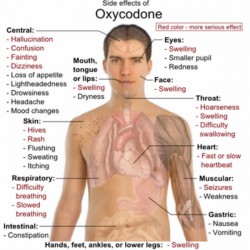
These side effects are not the only dangers associated with abusing oxycodone.
The number of deaths resulting from warfare pale in comparison to the rate of deaths associated with prescription opioid medications. Oxycodone is one of the more popular opioid drugs among recreational users. According to the University of North Carolina, prescription opioid medications accounted for 27,500 overdose deaths in 2007. This equals out to 4.6 times the number of deaths that occurred in both the Operation Enduring Freedom in Afghanistan and Operation Iraqi Freedom wars.
The dangers of oxycodone abuse start long before a person actually becomes addicted to the drug. From day one, oxycodone abuse exerts a gradual influence over the brain that grows stronger the longer a person uses. In addition to the overdose and addiction risk brought on by oxycodone abuse, users open themselves up to even stronger drugs of abuse, with heroin leading the pack.
Physical Dependence
Oxycodone’s effects in the brain integrate easily with the brain’s own natural chemical processes. As an opiate-type drug, oxycodone’s chemical structure nearly duplicate’s the brain’s own natural endorphin chemicals. With continued oxycodone abuse, the brain reduces its own supply of chemicals and lets oxycodone’s effects take over.
The danger of physical dependency increases as the brain comes to tolerate higher levels of oxycodone. Once a person starts experiencing withdrawal effects from oxycodone abuse, physical dependence has come full circle. In effect, anyone who takes the drug every four hours for a week or longer can become physically dependent on oxycodone’s effects.
Addiction Potential
Oxycodone abuse carries a high addiction potential the longer a person continues to use. While it may seem like physical dependence naturally precedes addiction, the potential for addiction has more to do with how a person behaves when he or she uses the drug. This means a person can be addicted without having developed a physical dependency and vice versa.
Once addicted, users have reached a point where they believe the drug is a positive part of their lives. At this point, negative consequences suffered from ongoing oxycodone abuse make no difference to the user.
Overdose Risk
Opioid drugs in general act as central nervous system depressants, slowing down most every vital function in the body, according to Loyola University. Oxycodone works in the same way. As long-time users have developed a fairly high tolerance for the drug, larger doses are needed to experience the desired “high” effect.
After a certain point, no amount of oxycodone will be able to induce a “high” once tolerance levels exceed the drug’s capacity. Under these conditions, a large enough dose can actually shut down the body’s breathing and/or heart functions, at which point the risk of overdose and death increases considerably.
Gateway to Heroin Abuse
Tighter restrictions on prescription drug dispensing practices have left many users unable to access needed drug supplies, according to USA Today. Between the years 2010 and 2011 alone, the number of people abusing prescription opioids dropped from 5,093,000 to 4,471,000.
As the number of opioid users declines, the number of heroin users goes up. Opiates class drugs carry a cross-tolerance effect that enables users to switch from one drug to another with relative ease. In effect, oxycodone abuse can easily give way to heroin abuse when users can no longer gain access to oxycodone supplies.
 Tolerance -
Whenever a user takes Oxycodone either for recreational purposes of as prescribed there is a risk that the user will develop a tolerance to the drug. Tolerance results from repeated use of a drug regardless of whether the drug is taken to relieve pain or if it is taken to produce a high, euphoric effect. As Oxycodone ...
Tolerance -
Whenever a user takes Oxycodone either for recreational purposes of as prescribed there is a risk that the user will develop a tolerance to the drug. Tolerance results from repeated use of a drug regardless of whether the drug is taken to relieve pain or if it is taken to produce a high, euphoric effect. As Oxycodone ...  Side Effects of Oxycodone Abuse -
There are many side effects associated with oxycodone abuse. If you begin to use this drug on a regular basis, you can expect your mental and physical health to be impacted negatively. Note: knowing the side effects of oxycodone abuse can help you pinpoint a problem in a loved one. The side effects of this ...
Side Effects of Oxycodone Abuse -
There are many side effects associated with oxycodone abuse. If you begin to use this drug on a regular basis, you can expect your mental and physical health to be impacted negatively. Note: knowing the side effects of oxycodone abuse can help you pinpoint a problem in a loved one. The side effects of this ...  Can You Develop an Addiction to Oxycodone -
Oxycodone is a narcotic pain medication that is prescribed for pain. It is an opiate medication such as Vicodin, Percocet and Codeine. It works by effecting the way transmitters in the brain receive pain and pleasure stimulus. Your body manufactures similar chemicals on it’s own like dopamine and endorphins. Can You Develop an Addiction to ...
Can You Develop an Addiction to Oxycodone -
Oxycodone is a narcotic pain medication that is prescribed for pain. It is an opiate medication such as Vicodin, Percocet and Codeine. It works by effecting the way transmitters in the brain receive pain and pleasure stimulus. Your body manufactures similar chemicals on it’s own like dopamine and endorphins. Can You Develop an Addiction to ...  Health Effects of Oxycodone Addiction -
When used in the appropriate manner, oxycodone is helpful in providing treatment of pain. Furthermore, since the drug has an extended release formula, pain treatment can last for a long time. It is important to only use oxycodone when prescribed by a medical professional. Doing so on your own, without medical supervision, can result in ...
Health Effects of Oxycodone Addiction -
When used in the appropriate manner, oxycodone is helpful in providing treatment of pain. Furthermore, since the drug has an extended release formula, pain treatment can last for a long time. It is important to only use oxycodone when prescribed by a medical professional. Doing so on your own, without medical supervision, can result in ...  What Happens in an Oxycodone Overdose? -
Oxycodone products are some of the most prevalent opioid painkillers marketed today. With hundreds of brand names including Oxycontin, Roxicodone, Percodan, and Percocet, oxycodone is used or abused by millions of people. On the street, high potency oxycodone pills became notorious for overdoses with the introduction of Oxycontin which became available in up to 160 ...
What Happens in an Oxycodone Overdose? -
Oxycodone products are some of the most prevalent opioid painkillers marketed today. With hundreds of brand names including Oxycontin, Roxicodone, Percodan, and Percocet, oxycodone is used or abused by millions of people. On the street, high potency oxycodone pills became notorious for overdoses with the introduction of Oxycontin which became available in up to 160 ...